Argument: Voices Under Fire
A first-generation Toyota pickup tears down a dry dirt road, kicking up clouds of dust behind it. Twelve passengers cling to the back, their lives shaped by seventy-eight years of civil war. Some have lost limbs, eyes, or organs to explosives planted by the Burmese military. All have lost someone they love. Yet they are singing. Not to mourn, but to celebrate the life they still have, and the fragile hope that one day they may live it in peace under a democracy.
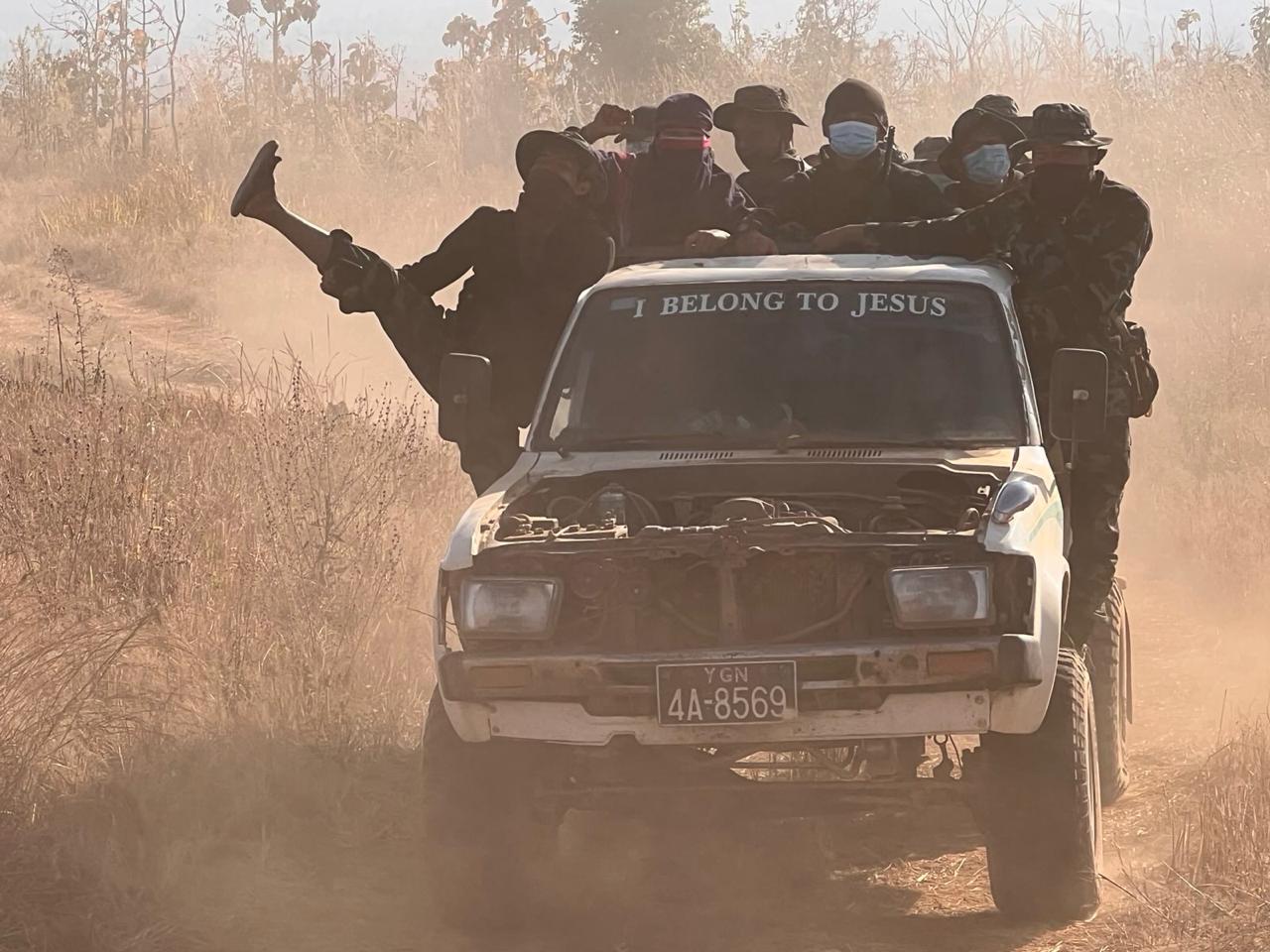
That image, preserved in Voices Under Fire through the artifact Free Burma Rangers on the Road, says more about the archive than any broad description could. The archive preserves not an abstract record of conflict, but moments in which people under dire circumstances remain connected to one another, search for hope of a more peaceful future, and exercise the resilience of the human spirit.
Voices Under Fire documents the experiences of internally displaced people, medics, and civilians living through violence in Myanmar. Through songs, interviews, letters, photographs, and testimonies, it gathers materials that record not only events but the ways people endure and describe them. The archive challenges official distance by keeping attention on voices that states, institutions, and even humanitarian reporting can flatten or leave behind. It also shows the limits of representation, especially when testimony passes through translation, transcription, and computational tools.
Historical Context
Myanmar’s civil war has produced mass displacement, severe violence, and a long humanitarian crisis. Documentation of those conditions comes from many places: local civil society organizations, international NGOs, medics, researchers, and displaced communities themselves. Haar et al., for example, combine survivor interviews with physical evidence to document patterns of violence against Rohingya survivors. Their study does not prescribe a single legal outcome, but it does show how narrative testimony and forensic evidence can reinforce one another in broader accountability efforts (Haar et al.).
That record, however, is unevenly organized. Matelski et al. describe a fragmented landscape in which many groups collect testimony across regions and populations. The problem is not simply abundance. It is coordination, repetition, and strain on the people being asked to tell their stories. That fragmentation helps explain why an archive like Voices Under Fire matters. Its value lies not in claiming completeness, but in holding together testimonies, photographs, songs, and letters that might otherwise remain scattered across missions, camps, and frontline movements. Accountability processes are also slow and uncertain, shaped by institutions that move far more slowly than the violence itself (Matelski et al.).
Digital activism forms part of this same landscape. Putra describes the #MilkTeaAlliance hashtag as a form of pro-democracy activism that increases visibility across borders and may feed into wider resistance (Putra). The archive works at a different scale. It is interested less in slogans than in the textures of resilience: a field surgery, a church choir, a handwritten note, a truck full of aid workers singing on the road.
Artifacts as Testimony
The “Joy and Pain” interview stays close to work that is concrete and immediate. Three members of the Karenni resistance describe treating landmine injuries and performing surgery in conditions of scarcity and danger. What gives the account force is the bluntness of the work itself: bodies to treat, supplies to improvise, losses that do not stop the next intervention from coming. Presner’s work on testimonial archives is useful here because it shows how digital testimony preserves more than sequence or fact. It also preserves narrative pressure and ethical weight (Presner).
Several visual artifacts make survival look communal rather than individual. Photos of demining instruction and landmine education show civilians learning how to live inside landscapes altered by hidden explosives. Training here is not a side note. Knowledge itself becomes a survival tool. Trauma is converted into shared expertise, or what Ibrahim calls a “technology of trauma” (Ibrahim). The point is not simply that people are endangered. It is that they are forced to become interpreters of danger in order to keep others alive.
The landmine photographs bring that reality closer. One image shows survivors with prosthetic legs. Another shows a young man injured while trying to remove a mine himself. These images do not need much interpretive buildup. They show what happens when explosive remnants remain in civilian space long after the moment of attack. The result is a political economy of risk in which ordinary people are forced to take on work that should never have belonged to them in the first place. MacLean’s argument that human rights facts are produced rather than simply found helps clarify that point. The photographs do not speak alone. Their meaning depends on framing, context, and the decisions that turn an image into evidence or testimony (MacLean).
The artifact “Free Burma Rangers on the Road” captures more than men riding in the back of a battered pickup truck. It shows what movement through war actually looks like. Bodies pile into an old Toyota with no hood, a windshield marked with the words “I belong to Jesus,” and worship music shouted into the jungle while the group travels from camp to camp and from frontline to frontline. Moss describes it as one of his favorite photos because it holds together things that should not fit in the same frame: danger, exhaustion, laughter, faith, and joy. The truck is moving through what he calls “a bad situation,” with attack and destruction all around, yet the men in the back are still singing. It does not simply show resilience in the abstract. It shows a specific form of collective hope, one expressed through song, movement, and worship in the middle of danger. Fu and Mahony describe digital storytelling as a way of bringing neglected voices into cultural memory (Fu and Mahony). This artifact does exactly that without announcing itself as theory.
Cultural Expression and Memory
The letters in the archive are among its strongest materials because they resist summary. One survivor writes what she cannot yet say aloud. She does so after severe injuries sustained in a firebombing attack carried out by the Burmese Air Force. Child victims write with a mixture of fear, gratitude, and ordinary greeting. These are small documents, but they shift the archive from general categories like “the displaced” to a collection of voices speaking outward.
Feminist scholarship on testimony helps explain why that matters. Testimony is mediated, shaped by structures of visibility, and marked by what archives tend to leave out (Albrechtsen et al.). But the letters do not need to be reduced to examples of exclusion. Their value is that they are still doing something in the present tense of the page. They thank, greet, reassure, and mourn. A survivor writes to the people who helped her. A child writes from the camp. The archive does not simply claim that these perspectives matter. It lets them remain visible in their own terms.
Music and communal worship do something similar. The recording of “Kabar Ma Kyay Bu” preserves a protest song closely associated with resistance after the coup. A church choir sings in a ruined space where worship continues despite destruction. These materials are not decorative additions to political history. They are part of how memory is kept in motion. Fu and Mahony show that digital storytelling can rebuild cultural memory through ordinary and previously neglected contributions (Fu and Mahony). In this archive, song and prayer carry that work without needing to be translated into abstraction first.
Archives and the Ethics of Witnessing
The archive also makes visible the problem of mediation. Hossain describes digital archives as sites of truth-telling and contestation rather than neutral containers (Hossain). Voices Under Fire does not simply store testimony. It arranges, translates, captions, and frames it. MacLean’s work on human rights fact production sharpens the point that evidence is shaped by methods, institutional settings, and interpretive choices (MacLean). The archive’s value lies partly in the fact that it does not hide that mediation.
An ethical question also sits beneath the collection process itself. Matelski et al. point to the fragmentation of documentation work in Myanmar and the strain repeated interviewing can place on participants (Matelski et al.). That concern matters for any archive built from vulnerable voices. The goal cannot just be accumulation. It has to be preservation without turning testimony into extractable material.
That tension becomes sharper once the archive turns to AI analysis. If testimony has already passed through violence, displacement, translation, and curation, then computational tools add another layer of mediation that has to be examined rather than assumed. Transcription models struggle with Burmese audio. Translation can flatten nuance. Image classification misses context. The result is not that AI is useless, but that it remains secondary. The tools can help organize material, but they do not resolve meaning. The Human Rights Center makes a similar point in work on digital evidence that unstable platforms and overwhelming quantities of content make human verification indispensable (Human Rights Center). In this archive, that lesson is plain. The more fragile the testimony, the less responsible it becomes to let automation stand in for interpretation.
Conclusion
The archive is most convincing when it stays close to the voices inside it such as the medic describing care under fire, the civilians learning how to identify mines, the men singing in the truck, the choir singing in ruins, the survivor writing because speech has not yet returned. Those moments do not need to be inflated into larger abstractions in order to matter. They already show what this collection preserves.
Voices Under Fire records how people continue to speak, sing, write, and teach in conditions designed to silence them. Scholarship on archives, testimony, and digital evidence helps clarify the stakes of that work, but the archive’s deepest lesson is not methodological. It is philosophical. Again and again, these artifacts show that even in a world shaped by violence, the Burmese people continue to act as if hope is still rational, as if dignity is still worth defending, and as if the future is still open. That may be the most striking form of resistance the archive preserves: not only the refusal to surrender, but the refusal to let evil have the final word. Its voices suggest that no matter how much is taken from a person, the human capacity to resist, to believe, and to hope can still remain.
Bibliography
Albrechtsen, M., et al. “Blind Spots: Feminist Memory, Gendered Testimony, and Cultural Trauma in Holocaust Memoirs.” Humanities, vol. 14, no. 8, 2025, article 168, https://www.mdpi.com/2076-0787/14/8/168.
Haar, Rohini J., et al. “Documentation of Human Rights Abuses among Rohingya Refugees from Myanmar.” Conflict and Health, vol. 13, 2019, article 42, https://pmc.ncbi.nlm.nih.gov/articles/PMC6745767/.
Koenig, Alexa, et al. Digital Lockers: Archiving Social Media Evidence of Atrocity Crimes. Human Rights Center, University of California, Berkeley, 2021, https://humanrights.berkeley.edu/wp-content/uploads/2021/06/Digital-Lockers.pdf.
MacLean, Ken. “Human Rights ‘Fact’ Production and Why It Matters: Myanmar as a Case in Point.” Asia-Pacific Journal: Japan Focus, vol. 20, no. 18, no. 6, 2022, https://apjjf.org/2022/18/maclean.
Matelski, Marion, et al. “Documenting Human Rights Violations in Myanmar: The Potential for Truth-Telling and Accountability.” Netherlands Institute for the Study of Crime and Law Enforcement, 2022, https://nscr.nl/en/documenting-human-rights-violations-in-myanmar-the-potential-for-truth-telling-and-accountability/.
Putra, Bama Andika. “Digital Activism in Southeast Asia: The #MilkTeaAlliance and Prospects for Social Resistance.” Frontiers in Sociology, vol. 9, 2024, article 1478630, https://pmc.ncbi.nlm.nih.gov/articles/PMC11625999/.